

Curiosity Was Your First Superpower. You Gave It Up.
Don’t Panic. But Maybe Start Wondering Again.

On the 4th of July, after spending part of the day in the water, my son kept crawling back to the edge of the swimming pool. He kept crawling back to the rim, leaning forward to peer into the water with quiet focus. Sometimes he dipped a hand in, other times he just watched the way the water moved. It wasn’t fear. It was study. A quiet kind of observation. A careful return to something new.
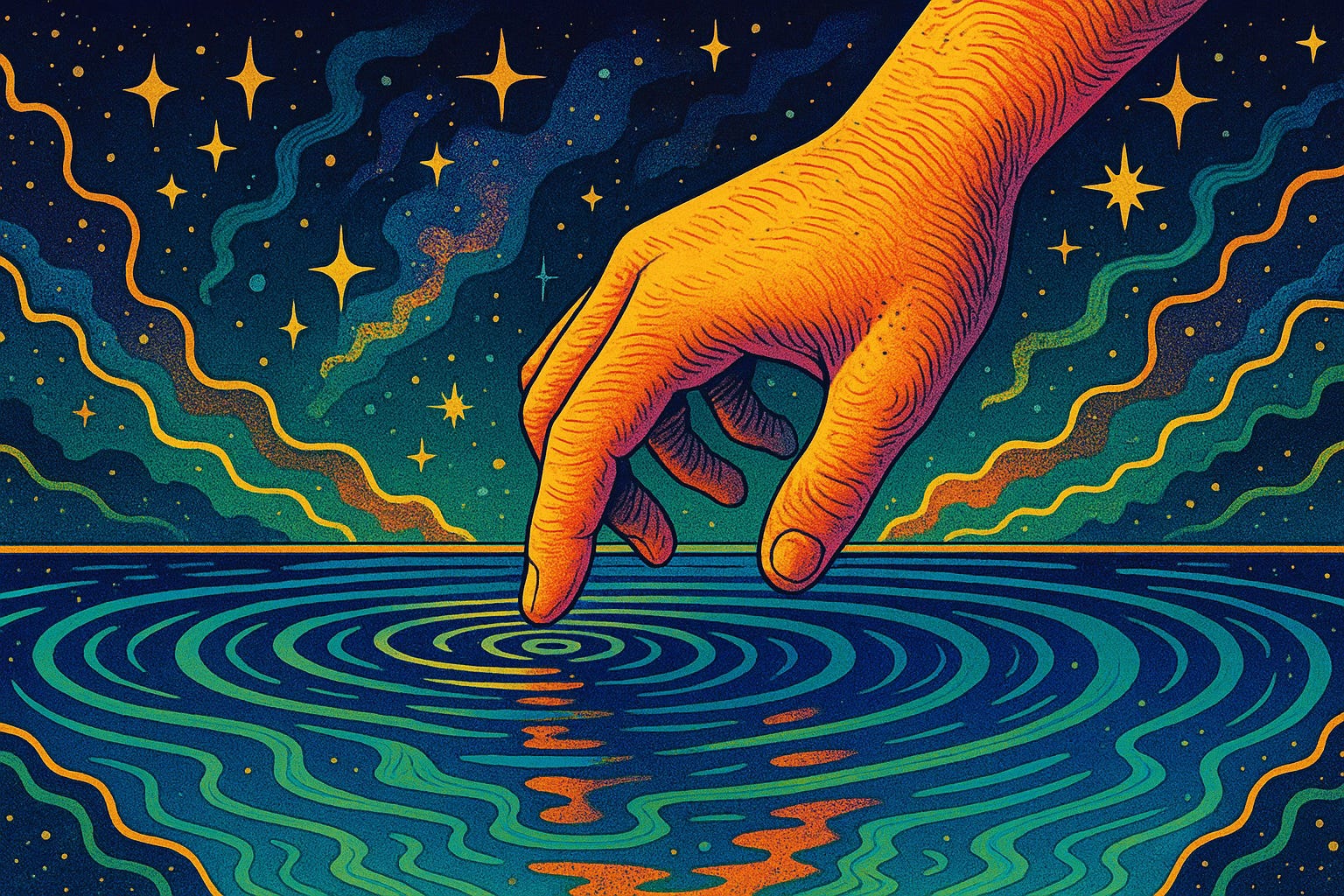
The whole time, a friend and I were watching and started talking about what it means to be curious as a kid. We had different childhoods, they were more outgoing, I was quieter but we both identified as curious adults. That got me thinking: what propelled that curiosity? Did we have people in our lives who encouraged us to ask more questions?
Who or what gave us space to wonder or tools to explore?
Our answers were different, although we both agreed that we didn’t have others modeling how to be “curious.”
They attributed their curiosity to undiagnosed ADHD. A need to be entertained, to fixate, to stay stimulated. I attributed mine to escapism. I was quiet, rarely outgoing. I didn’t feel like I could get what I needed from the people around me, so I dove into books, asked questions, and observed people constantly. That’s how I pieced together my understanding of the world, through questions no one asked and books no one handed me.
I didn’t know what I was looking for, exactly. I just knew I wasn’t getting it where I was. Somehow, through all that wandering, I ended up with something better than answers: a worldview.
Now, decades later, I was watching my son revisit the edge of a pool with the same steady wonder I once brought to dusty stacks of books.
If you’re into education, queerness, and cracking open the systems we take for granted—subscribe.
The Hitchhiker’s Way
I didn’t grow up in a world of explanation. I grew up in a world of silence or certainty. If I wanted to understand how the world worked, how people worked, I had to go looking for it. So I did. Mostly in books.
As a latchkey kid in middle and high school, I used to spend entire afternoons in the library doing homework, flipping through encyclopedias, or whatever strange section the Dewey Decimal System led me to. I didn’t always understand what I was reading, but I felt something click when I stumbled into an idea I’d never seen before. Those moments felt like mine. Earned. Uncovered. Private.
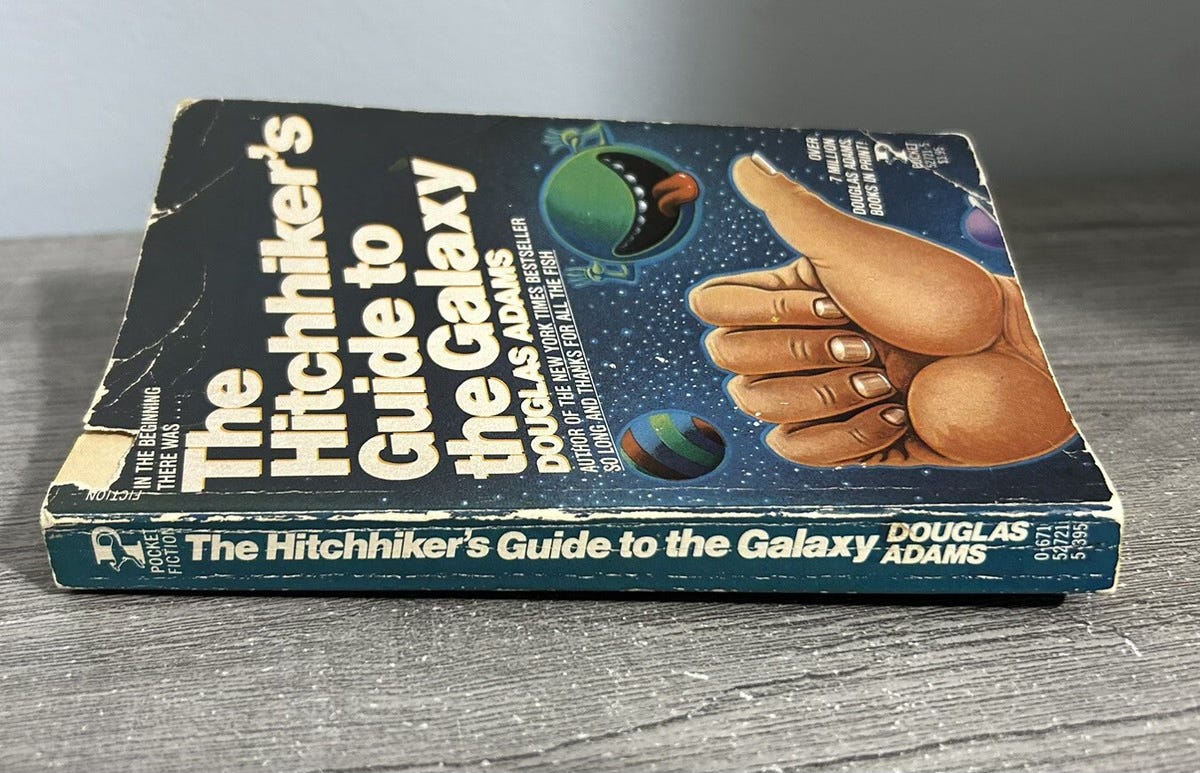
The first book that really felt like it got me was The Hitchhiker’s Guide to the Galaxy by Douglas Adams. It was offbeat, irreverent, and full of sharp social commentary that felt like a departure from everything else being handed out in English class. It was clever without being condescending, smart in a way that didn’t show off. It taught me that curiosity doesn’t have to be serious or orderly. It just has to be honest.
Or as Adams put it, “There is a theory which states that if ever anyone discovers exactly what the Universe is for and why it is here, it will instantly disappear and be replaced by something even more bizarre and inexplicable.”
As a teacher, I tried to recreate that feeling for my students. I built lessons around questions. I left room for exploration. I made curiosity the foundation, not the reward. Still, many students didn’t bite. They did what was asked. Rarely more.
I used to take that personally. Now I wonder if it’s not about them. Maybe it’s about all of us.
Curiosity Is a Muscle
We’re living in an age where everything is broken down for us, TikTok clips, autoplay news, algorithmically suggested opinions. Many headlines claim our attention spans are now shorter than a goldfish’s, but experts argue this comparison is misleading and oversimplifies how attention works in the digital age. Still, most people accept it as fact and rarely question its origin—ironically proving just how little we tend to stay curious.
And with over 70% of YouTube views coming from algorithm-driven recommendations, we rarely go looking for answers. We wait for them to be handed to us. Ten-second clips. Algorithm-curated facts. Firm points of view delivered like gospel.
There’s very little room to be curious when the internet is trying to finish your sentence for you.
So what are we doing here if the goal is always consumption and never confusion?
When was the last time you changed your mind and didn’t feel ashamed about it? When you let yourself be wrong and stayed curious instead of defensive?
I kept thinking about my son at the pool, not just as a sweet memory, but as a real-time metaphor for curiosity: incremental, repetitive, and self-motivated.
Research backs this up. When we allow ourselves to stay in that place of not knowing, when we pause before skipping to the answer, our brains actually get better at learning. Research from UC Davis shows that curiosity not only helps us remember what we’re interested in, but also boosts memory for unrelated information by activating the brain’s reward system. In other words, the more curious we are, the more our brains light up and store information. Even about things that seem unrelated. It’s not just good for kids in school. It’s good for adults trying to understand the world.
Other studies show that curiosity improves creativity, workplace engagement, and even our ability to hold conversations across differences. It helps us listen, imagine, and link ideas in new ways. And it cultivates patience, the very thing we often run out of in this era of quick takes and algorithmic certainty.
So maybe curiosity isn’t just a personality trait. Maybe it’s a muscle. One we’ve let atrophy. One we can still choose to use.
Curiosity isn’t just about asking questions. It’s about not knowing and still wanting to move forward. It’s about being okay with discomfort, wonder, and complexity. Somewhere along the way, we started rewarding certainty instead.
But that instinct? The one that made me pick up a dryly philosophical British sci-fi book or made my son reach toward the shimmering pool water again and again? That’s still there.
We just have to make space for it.
Make Space for Wonder
When was the last time you stayed with a question instead of rushing to Google it?
When did you last wonder, without trying to fix it?
Let’s start there.
Because somewhere along the way, most of us stopped being curious. Not just about science or strangers or systems, but about ourselves. We accepted shortcuts as wisdom. We confused certainty with safety. We learned to consume instead of wonder.
And when we try to reconnect with curiosity, we often reach for nostalgia—recreating childhoods we barely remember instead of imagining something new. Sometimes it's easier to perform the past than question what the future could be.
So whether you have a kid or not, when did you stop asking questions no one assigned you?
What are we doing here, if not trying to get better at wondering?
What are we doing here… if not trying to stay curious?
Don’t Panic. But Maybe Start Wondering Again.
🌀 Curious? Here are some things that often pull me back into a state of wonder when I feel like the world is too loud, small, and frustrating:
The majority of atoms in your body are hydrogen, the oldest element in the universe. So we’re all made of the same stuff as stars.
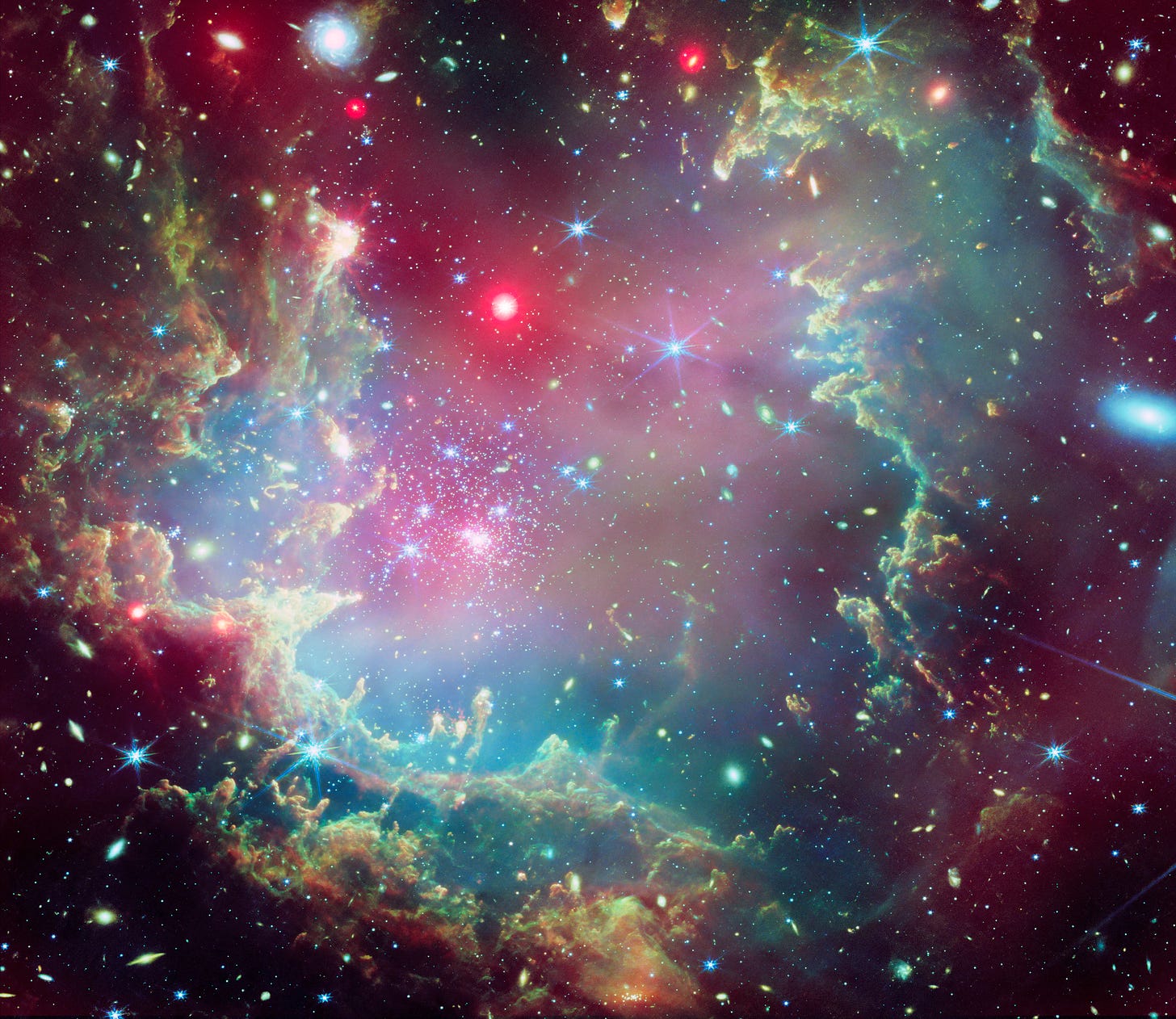
Speaking of stars, images from the Webb Space Telescope always spark wonder. Like this one of a cosmic “wreath” that displays large stars closest to our solar system, along with numerous other galaxies.
Maps are lies. The Mercator projection distorts the size of countries to favor colonial powers. Greenland is not bigger than Africa. What else have we “learned” that distorts truth?
Every person alive shares 99.9% of their DNA with every other human. A reminder of connectedness and sameness beneath difference.
There are more neurons in your brain than there are people on the planet. The average brain contains an estimated 86 Billion neurons, while the planet has roughly 8.3 Billion people.
Matt! You've done it again. This is such an excellent piece. It's so very much inline with all the things I've been thinking about recently. Casey and I have taken to leaving our phones far away as often as we can, and the conversations we have and hypothesizing we do are so much more creative and better for it. Thanks for reminding me of the beauty of wonder.
As a retired public school teacher, I also lay some of the responsibility on statewide high stakes testing. After No Child Left Behind when states started implementing high stakes testing, school curricula started changing. That’s when all that “teaching to the test” furor began. With that as an antecedent the new trend to AI and chat bots is like a disastrous perfect storm for education.