

school is boring
treat young people, like people, not data points

As I have spent the past 2 weeks in Spain trying to get a feel for what it would be like to live here and raise a child with my husband, one thing keeps sticking out: students are out in the real world exploring during the school day, as a part of the the school day. Whether it is the hoards of students, Spanish, French, and English, that are touring a museum, or the smaller groups working out in a square, reading and drawing, it is a clear difference from what I see in the U.S. and far from what I was capable of creating as a science teacher in Los Angeles. Our field trip policy was so dramatically altered to favor “virtual field trips” that we couldn’t take our Biology students to the aquarium or the local wetlands to witness active ecosystems unless it was spread out over multiple days, with a seemingly endless list of background checks for chaperones and slow approvals needed from multiple tiers of disjointed district officials. So this week, I am reflecting on why school in the U.S. is boring and look forward to hearing your thoughts on this.
The one thing I hear the most from students, and from adults, is that “school doesn’t prepare you for the real world.” And you know what? It’s true, to an extent. When students expressed this, I would tell them they’re right. That in my life experience there has never been a time where I used the pythagorean theorem (that I can actively remember), or during an interview someone asked me to explain the Louisiana Purchase. I believe this honesty helped frame the next part, which is that although those things haven’t directly presented themselves, knowing that they exist, and generally knowing why they are important, or how they can be used, has helped me be curious and discover other things that are applicable to my everyday life.
Too often, school feels disconnected from the world students actually live in. It’s a system that rewards compliance over curiosity, test scores over deep understanding.
Learning should be more than that. It should be about making sense of the world, about finding connections between history, identity, and lived experiences.
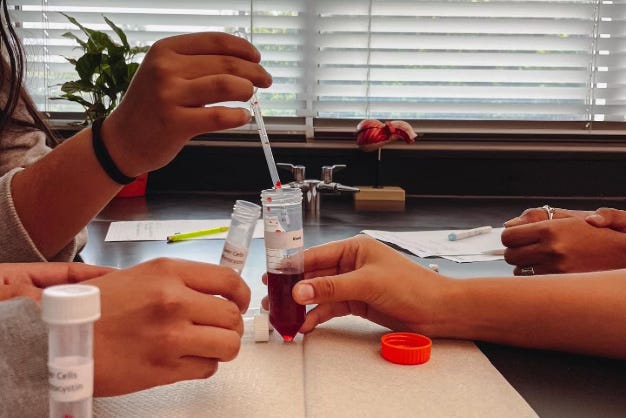
I’ve spent most of my life in education, as a student, as a teacher, as someone who sees school as both a refuge and a battleground. If there’s one thing I know, it’s that students will invest in learning when they feel like they belong in it.
When I was a kid, I was good at school because I had to be. If I excelled, I wouldn’t be questioned. If I buried myself in knowledge, no one would ask what I was hiding. Education wasn’t about discovery, it was about protection, about survival.
I know I’m not the only one. So many queer students, so many students from marginalized backgrounds, have learned to navigate school like it’s a game of survival, or as a refuge from the places they feel most vulnerable.
Learning shouldn’t be about survival. It should be about liberation.
That’s where humanizing pedagogy comes in. Humanizing pedagogy is an approach to teaching that prioritizes the lived experiences, voices, and identities of students. Instead of seeing students as empty vessels to be filled with knowledge, it recognizes them as active participants in their own learning; people with histories, cultures, and emotions that shape how they engage with the world. It is rooted in Paulo Freire’s belief that education should be liberatory, that students and teachers should be co-learners, working together to critically examine the world and act upon it. If we want students to engage, if we want them to see school as a place that matters, then we need to start seeing them first.
Humanizing pedagogy isn’t just about teaching content, it’s about teaching people. It’s about recognizing that education isn’t neutral. It’s about asking: Who gets to learn? Who gets to belong? Who gets to shape the story?
School doesn’t have to be boring, it can be a place of real-world connection and engagement. Instead of teaching the Pythagorean theorem as an abstract mathematical concept, students can analyze ADA policy by surveying wheelchair access ramps in their neighborhoods, determining whether their communities are truly accessible. Instead of memorizing the parts of a cell, like the mitochondria, students can conduct neighborhood surveys of green spaces, track seasonal temperatures, and compare which areas are more suitable for living; prompting deeper questions about infrastructure disparities and environmental justice.
This is why representation matters. Not just as an abstract concept, but as a fundamental requirement for meaningful learning. If students can’t see themselves in their curriculum, in their history, in the people who stand in front of them every day, then what we are telling them is that their experiences do not matter.
When students believe their experiences do not matter, we lose them. When students aren’t part of the story, they stop engaging with it.
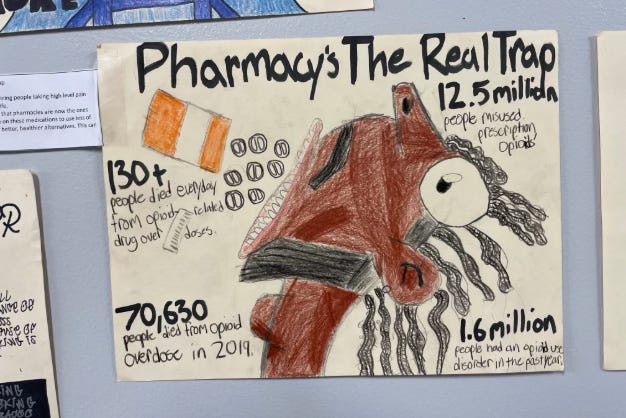
We are already watching that loss happen. The rollbacks of DEI, the removal of queer and racial histories from school curricula, the insistence that education should be neutral. This is not an accident. They are strategies of control. They are an attempt to create a generation that does not question, does not engage, does not resist.
Education has always been about resistance.
The students who led the fight for ethnic studies in the 1960s, the young people who fought for LGBTQ+ rights before Stonewall, the student walkouts that have shaped history - none of those movements happened in schools where students were told to stay quiet.
They happened because students saw themselves in history and decided they belonged there, and they were committed to making sure they were seen and heard, when it was clear so many wanted them to just fall in line and follow instructions.
This is why humanizing pedagogy matters. Because when students feel seen, they invest. When they feel like their experiences matter, they engage. When they feel connected, they build radical empathy.
Radical empathy is what changes the world. Humanizing pedagogy doesn’t just shape how we teach, it shapes how we live. When we learn to see young people as full human beings, we learn to see all people that way. It teaches us how to coexist with those who are different from us, how to build connections across divides, how to engage with perspectives that challenge our own. In a time of increasing polarization, this is not just a teaching method, it’s a way to reshape how we relate to each other as a society.
So the question isn’t just: What do we teach?
It’s: How do we teach in a way that reminds students that they matter?
The more students, and young people believe that, the harder they will fight for a world that reflects them.
Right now, we need that fight more than ever.
-matt
This is an interesting read. I do believe that education needs an overhaul and it should be centered on the individual's innate curiosity and what their strengths, weaknesses and goals are. Allowing one to explore the world is part of this journey, and who knows, maybe they will discover something that they may not have otherwise thought of.
I love this so much. The things that I remember most about school are all the opportunities we had outside of the classroom that applied our learnings to our lives, exactly what you're saying here. 👏🏼👏🏼👏🏼