

teaching is political because learning is personal
if you want students to ask big questions, start by answering theirs

My students were heads down, working through their final assessment for our Evidence for Evolution unit. For weeks, they had been piecing together the story of life on Earth through labs, data analysis, and argumentation. They used core Science and Engineering Practices (SEPs) — modeling evolutionary relationships, interpreting fossil data, constructing explanations from evidence, and engaging in argument driven by scientific reasoning. From continental drift and Pangea to natural selection and homologous structures, they built a solid foundation not just in content, but in how to think and communicate like scientists.
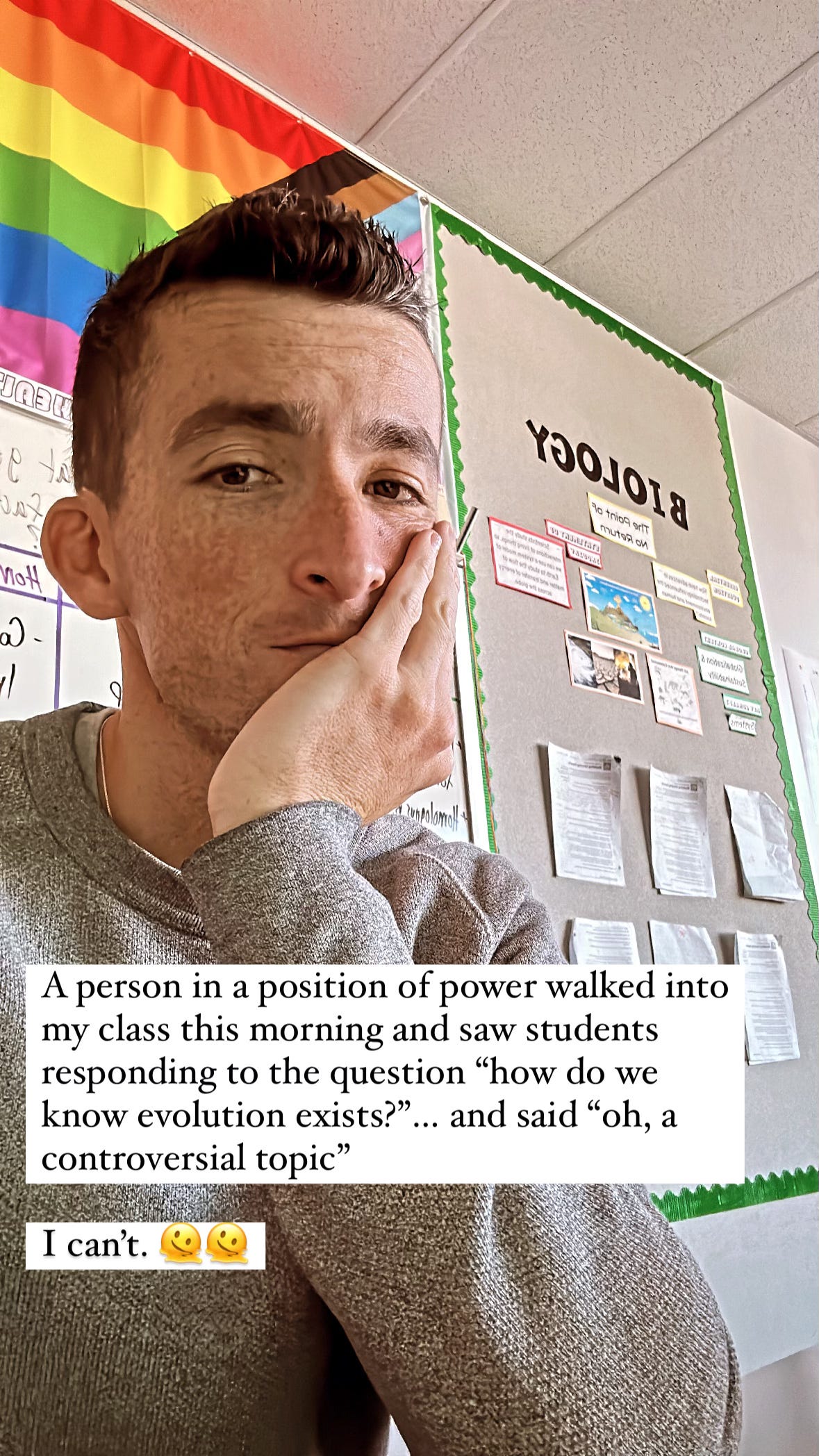
That’s when my principal walked in.
They scanned the room, saw the assessment title, Evidence for Evolution, and with a smirk said, “Evolution, a controversial topic.”
It wasn’t a joke. It was a reminder.
At that moment, it was clear that the work my students had done, the hours of data collection, model building, and evidence-based writing, was seen as inherently political. Not because we were debating opinions, but because science itself was being framed as a belief system. I told my students, “It’s not controversial, it’s science. And science uses evidence instead of feelings” And we kept going.
That moment wasn’t isolated. It was part of a larger pattern I saw over and over, the pressure to treat objective knowledge like a personal opinion, to water down evidence so it didn’t upset anyone’s worldview. The reality is, teaching is political not because teachers are pushing an agenda, but because knowledge is power, and power makes people uncomfortable.
The Myth of Neutrality
There’s a popular refrain often lobbed at teachers like a warning shot: "Leave politics out of the classroom."
It’s nonsense.
Every teacher brings their full self into the room, whether they acknowledge it or not. My students knew I was queer, not because I gave a speech about it, but because they asked me what I did over the weekend, and I didn’t lie. They knew what music I loved, what books I recommended, and how I felt about curiosity and asking questions. They knew because teaching is relational, and you can’t build relationships with students if you’re pretending you have no life outside the school parking lot.
This idea that teachers must be neutral, that we should somehow strip ourselves of our humanity before stepping into the classroom, has always been absurd, and it’s never been applied equally. A pregnant teacher can celebrate their growing family without anyone accusing them of pushing a “family values agenda.” A straight teacher can mention their spouse or hang wedding photos by their desk, and no one bats an eye. But a queer teacher mentioning their partner? That’s suddenly “political.”
The double standard is obvious, and it reveals the truth: It’s not actually about keeping classrooms neutral. It’s about controlling which identities are seen as acceptable.
Who You Are Shapes How You Teach
One of the first things I asked my students to do every year was tell me who they were. Not just their names, but the story of their names — where they came from, who gave them to them, what they wanted me to know. I wanted to know if they were the oldest kid in the house or the youngest. Whether they loved soccer, anime, cooking with their grandma, or gaming until 3 a.m. Every piece of who they were mattered, not because I was nosy, but because good teaching starts with knowing your students.
It always shocked me that the vast majority of my students had never asked someone in their family where their name came from, and it was always the best to see their excitement when they shared what they uncovered.
If you want to build that kind of trust and curiosity in your own classroom, I created a free digital download designed for the first week of school, but can be used whenever you need it. It helps teachers center student identity through a simple but powerful activity, because that’s not political either. It’s just good pedagogy.
The flip side of that is this: My students deserved to know who I was, too. Not every detail, but enough to see me as a whole person. I asked them to show up fully, so I did the same. They knew I worked in advertising before teaching, they knew I ran to clear my head, and they knew my partner was my favorite person in the world, that we have 2 dogs, and that we like to travel and eat good food. Not because I made it a point to tell them, but because that’s what happens when you build real relationships.
When we strip classrooms of human connection, when we tell teachers to leave their identities at the door, we aren’t protecting students. We’re robbing them of the opportunity to see learning as part of life, not just something that happens in a textbook.
Why Curiosity Is Political
If you want people to be curious, to really love learning, you have to give them a reason to care, and caring comes from connection. It comes from seeing how what you’re learning connects to who you are, what you’ve experienced, and the world you live in. That’s why people ask questions, not because they want to memorize facts, but because they want to understand how those facts shape their lives.
The push to make classrooms “neutral” isn’t about protecting kids. It’s about controlling what they’re allowed to care about. It’s about limiting the questions they ask, the connections they make, and ultimately, the power they have to shape their communities.
That’s not new. Throughout history, authoritarian regimes have always targeted education first. They know that controlling what people know, and who gets to know it, is the easiest way to maintain power. I'll dive deeper into that in a future post, but for now, just know this: When people fear education, it’s not because they’re worried about students being indoctrinated. It’s because they’re terrified of what happens when they start thinking for themselves.
Build Community With Your Community
For Teachers
👉 Want to build a classroom culture that honors student identity from day one (or day 114)?
Download the free resource here and see how the lesson can work for your class. Everything is already created and will have you ready to go in less than 5 minutes: lesson plan, slides, student resources. Let me know what you think, and how it could be improved.
For Parents, Caregivers, and Everyone Else
Think about your own school experience. Who were the teachers that made the biggest impact on you? Were they the ones who stuck to the script, or the ones who showed you who they were? Let’s talk about it.
I’d love to hear your stories and better understand how we can support empowering educators in your community. Drop a comment below or share this piece with someone who still believes classrooms can be neutral.
Extra Credit
If this piece sparked some curiosity, here are a few recommendations that explore the intersections of science, humanity, and our place in the world (all of which I used in my classroom):
🌍 The Sixth Extinction by Elizabeth Kolbert: A gripping exploration of how human activity is reshaping life on Earth and driving a mass extinction.
🌿 Braiding Sweetgrass by Robin Wall Kimmerer: A beautiful reflection on Indigenous knowledge, ecology, and how we can build a reciprocal relationship with the Earth.
🎥 A Life on Our Planet: David Attenborough’s powerful Netflix documentary, a personal witness statement to the state of the planet and a hopeful vision for how we can repair it. [Watch on Netflix]
-matt
I loved this - you sound like you are a fantastic teacher and one I wish I had had growing up.
This was a great article @Matt Fitzpatrick! This week I wrote a similar article about the moral duty educators have to their students written through the lens of a previous student, me (I’m not an educator.) I grapple with the topic of being queer in high school in the early aughts. Our writing has intersections on the subject of neutrality/value-neutral. I speak about German Philosopher, Max Weber, and how his theory of neutrality is dangerous to marginalized students. It was really helpful to read your article from an educators point of view. I actually wish I had read this before I wrote mine. If you have any interest in philosophy or morality, please give it a read. https://themoralityof.substack.com/p/the-morality-of-the-educator