

When We Talk About Adolescence, We Should Talk About All of It
This isn’t just a crisis of masculinity, it’s a failure of adult responsibility.

This post contains spoilers to theNetflix limited series Adolescence.
Why This Matters: Netflix’s Adolescence isn’t just a gut-punch, it’s a mirror. What it reflects is a school system still obsessed with control, unprepared for digital realities, and dangerously under-equipped to support the kids it claims to serve.
The Big Idea: We don’t just have a “boy crisis”—we have an adult accountability crisis. If we’re going to tell stories like this, we better be ready to talk about what comes next.
Key Takeaways:
Shared responsibility is non-negotiable. We can support boys without sidelining girls. This isn’t a zero-sum game.
Digital harm is real—and ignored. Schools preach tech literacy but can’t keep up with how students are actually living online.
If you’re an adult, you’re part of the story. What you model—about care, tech, and trust—matters more than what you say.

When It’s Not Just a Show Anymore
I put off watching Adolescence longer than I meant to—not because of my crawling nine-month-old, but because I don’t do “intense” without building a little emotional armor first.
Something about what Eddie says in the last episode cracked through that armor anyway: “I’m sorry, son. I should’ve done better.” There was no hypothetical reaction of how I would interpret that as a dad, but for the first time, I sat in silence contemplating all the possibilities. I came out of the haze with more questions than I had answers. My memories as a son begged for clearer context. My instincts as a teacher wondered if outcomes I once considered acceptable would be enough if it were my own son.
What We’re Getting Wrong About Boys
Much of the discourse around the series has focused on why 13-year-old Jamie killed his classmate and if the representations of young boys interacting with each other and adults is an accurate depiction of the crisis young men and boys are currently facing. I keep returning to the title: Adolescence. It’s not "young men" or "boyhood.” It’s adolescence, the term to describe the full psychological and physical transformation from childhood to adulthood, across gender and experience. There seems to be an ever growing conflict between parents and schools, one where the solutions to common and emerging challenges takes a confrontational approach that leaves young people in the middle, fending for themselves. The outbursts in the classroom, the instigations in the hallways, and the online taunting all spill over into the collective lives of the student body and into the lives of the broader community. The solutions, then, must be shared too. Not just what we do for boys, but what we do as and for the collective. The adults. The systems. The environments that shape kids long before they become a piece of content in your fyp.
As a new father, I’m painfully aware that my son will be shaped by far more than what my husband and I cultivate at home. There will be friends, other families, and—as this series and my time as teacher makes abundantly clear—school dynamics that throw everything into a blender and hit "Pulse." I’ve been in this dad role for less than a year, and I don’t pretend to have answers, especially since the highlight of our week was learning how to say “ahhh” after sipping water, but being a teacher has already changed how I think about decisions around education and my son. Whether it’s hearing staff from the elementary school behind my house yell at third graders to quietly line up, with the threat of losing the next recess, or sitting through countless professional development and faculty meetings hearing the latest approaches to classroom management, there’s a clear message: school isn’t built for flourishing, it’s built for control. We say we want curiosity, but we reward compliance. That contradiction sits at the core of the problem.
Control is Not Care
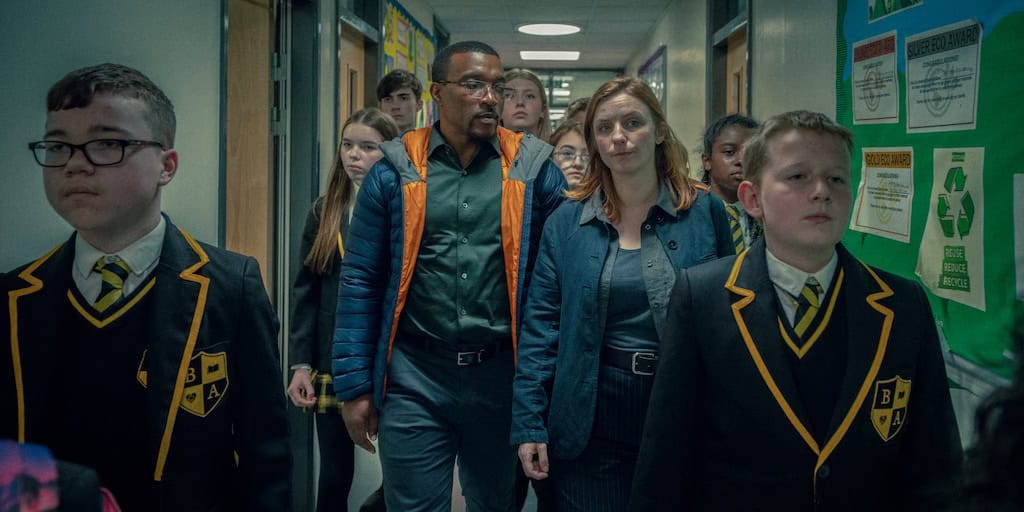
In Episode 2, Detective Inspector Bascombe calls the school a "holding pen," and he’s not wrong. Every year brings a new initiative complete with some glossy poster, a new acronym, and a repurposed slide presentation read out at a faculty meeting. What we’re doing isn’t adapting, it’s stacking. It’s dressing up old habits in a new language and hoping that this time it sticks. Take Positive Behavioral Interventions and Supports (commonly referred to as PBIS), a tiered framework that is marketed to promote positive student behavior, improve school climate, and reduce discipline issues by consistently and proactively reinforcing expectations. It includes slogans like “Be Respectful, Be Responsible, Be Safe” and is usually paired with a rewards system—access to snacks and games, maybe a public shoutout—to incentivize compliance.
The problem is that it rarely addresses the actual reasons students struggle in the first place. Instead of building trust or curiosity, it conditions students to perform compliance for rewards. It rewards the quietest voice, the stillest body, the student who “looks" most like success. PBIS repackages systemic bias into point systems and slogans.
What I want, what I hope for as a parent, isn’t another repackaged plan or one-off solution. It’s fewer changes, and greater impact. Changes that are data driven, resourced, revisited, and built around actual student needs, not adult ego, nostalgia, or fear of pushback. That requires an entire community to be involved.
Teachers Aren’t Equipped for This
It doesn’t matter if a teacher knows how to upload to Google Classroom or run a group chat in Discord because students are already communicating, coping, and sometimes collapsing through a digital lens that’s moving faster than we can name it, let alone create responsive, well-informed, data-driven policies around it. With the release of Adolescence, there’s a push in the UK to show the series in classrooms. But what does that really do? What harm does it risk if the teachers in those rooms aren’t equipped to use the content as a learning tool? What happens when students who have lived through these kinds of online bullying or digital isolations are made to rewatch their pain without a plan for healing? I keep coming back to Mr. Malik, the young, seemingly burnt-out teacher in the series, left alone in front of a class full of tense teenagers and a paused screen, asking, “What am I supposed to do?” The truth is, many of us have been Mr. Malik. Earnest. Underprepared. Looking for someone to tell us what to say when a kid’s face changes. When the air in the room shifts. When what we planned isn’t what they need, parents are not returning our calls, and administrators are telling us after a 15 minute observation that our classroom management would be better served if students could see the objective of the day written on the board.
The emotional labor of teaching is everywhere in Adolescence. I’ve felt it too. I once had 40 high school students in a single classroom. Forty. Each with different needs, IEPs, interests, triggers, and phones buzzing nonstop. One day, you’re talking a student through their anxiety over a biology project. The next, you’re de-escalating a hallway fight while 10 kids film and ten more pretend not to notice. Then, when it’s quiet again, you’re expected to keep teaching like nothing happened. While another student is quietly crying into their notebook, and another is stopping by to get a menstrual pad from the supply you keep because the school supply won’t get replaced. In this modern age of teaching, where more and more potentially great educators are opting out of careers in the field, and students need more empathetic and excited role models, we can only do so much. Not because we don’t want to do more, but because our own self preservation and families need attention too.
We Can Hold More Than One Truth
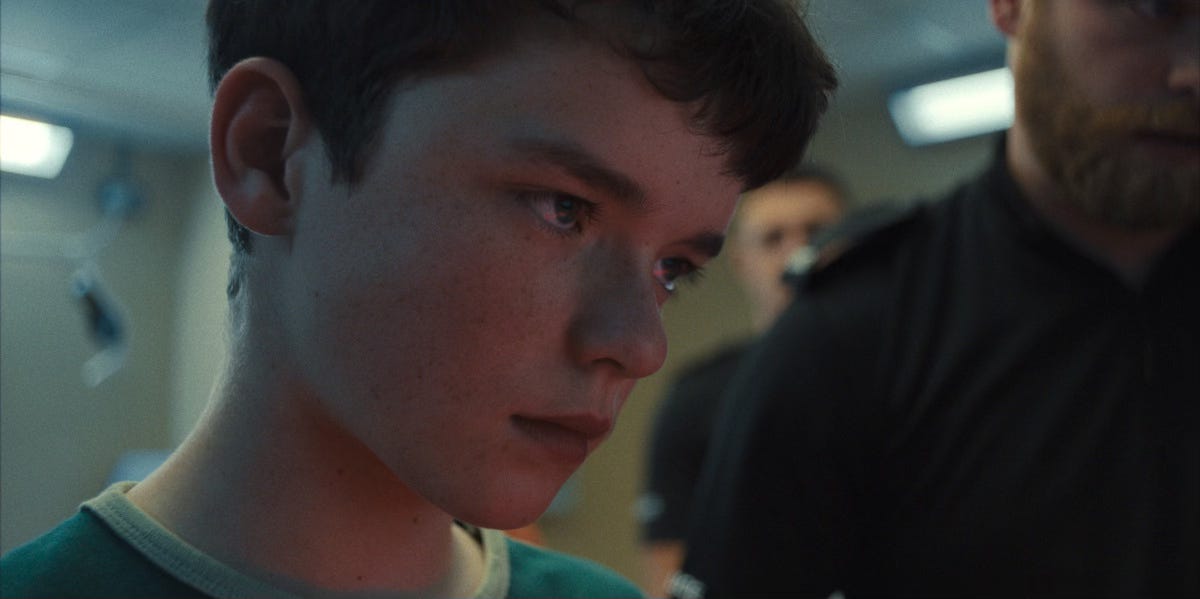
We have to be able to hold space for more than one truth: for one group of students to thrive, others don’t have to be sacrificed. The elevation of girls’ needs in education—long overdue and still incomplete—shouldn’t mean that boys only get seen when something goes wrong. Somewhere along the way, boyhood has become synonymous with risk, with danger, with toxicity in need of reform. Yes, some of that behavior is harmful and some of it needs to be named and disrupted, but we can’t lose sight of the fact that boys like Jamie aren’t just perpetrators in waiting, they’re also kids who are being bullied, isolated, and humiliated online. Not as an excuse, but as context. Even in Adolescence, we see Jamie being targeted digitally by his peers, and yet the dominant narrative remains his violence, not the conditions that shaped it. For all the years we spent pushing anti-bullying campaigns into schools—assemblies, pledge walls, spirit weeks—what do we have to show for it? Most young people now see those programs as performative at best, laughable at worst. And they’re not wrong. If we don’t put meaningful action and relational care behind the messaging, we can’t be surprised when the message doesn’t land.
The Digital Divide Isn’t Just About Access
I don’t want school to feel like containment for my son. I want it to feel expansive. My husband and I are already talking about tech—but not in the way schools often do, through bans or blanket policies. We’re talking about presence. About how to have friendships that exist outside of screens, and how to know when your brain is tired from scrolling, not just tired from the day. But tech isn’t the enemy, misunderstanding it is. Too many adults, both parents and teachers, model overuse or avoidance instead of fluency. If we want kids to move through adolescence with digital tools instead of digital damage, we need to start by understanding the terrain ourselves. We can’t just assume that because young people are constantly on a phone, that they know how to use and moderate it. They don’t and can’t.
Better Doesn’t Mean More
Eddie doesn’t say he should’ve done more. He says he should’ve done better. That’s what sticks with me. Just… better. Better listening. Better noticing. Better support and follow through. We may not know exactly what better looks like, but we know what worse looks like, and we’ve lived with it long enough. Shared responsibility means we don’t wait for perfect policy or perfect timing. It means noticing earlier. Asking better questions sooner. If you’re an adult in a child’s life, you’re already part of the story.
If you have seen the series, let me know what parts of the show connected with you the most.
If you haven’t seen the series, it is available on Netflix.
-matt
This hit home so hard. Thank you for caring. Thank you for sharing this.
Couldn’t have said it better myself! (and I tried to) This a beautiful take on a deeply complex and important issue.