

who gets to exist?
a humanizing approach to representation in education & parenting

The first time I saw a queer person in my school’s curriculum, I was the one who had to introduce them. That moment didn’t come from a lesson plan, a textbook, or even a well-meaning teacher—it came from a middle school research project on discrimination where I had no choice but to pick LGBTQ+ discrimination because every other topic had already been taken. And because I had spent so much time trying to blend in, that moment felt like I was turning on a spotlight that pointed directly at me, and the giant secret I was desperately trying to keep hidden.
I didn’t see myself in the world around me, so when I started uncovering stories like Stonewall, I wasn’t just researching a school project—I was finding proof that I existed. Proof that people like me had always been here, had fought, had lived, had mattered. And yet, that history had been intentionally left out of my classrooms, my community, and because of the limited resources available, had been recounted in the darkest, bleakest, and most painful terms.
Now, decades later, we’re watching this same erasure happen again, but on a broader, systemic scale. The rollback of Diversity, Equity, and Inclusion (DEI) programs, the banning of LGBTQ+ books, the removal of Black and Indigenous histories from school curriculum—this is all part of a larger effort to decide who gets to be visible. Who gets to feel seen. Who gets to belong. And just as importantly, who doesn’t.
Representation isn’t just about seeing yourself—it’s about validating who is allowed to belong and normalizing who is erasable.
the contradictions of visibility
The truth is, visibility has always been a battleground. When we talk about representation, we’re talking about power. Who gets to shape the narratives? Who gets to be the hero? Who is cast as the villain? And who is missing altogether?
When I was a kid, the rare moments of representation I saw were filtered through a heteronormative, whitewashed, and deeply limited lens. And yet, sometimes representation broke through in ways that no one predicted. The queer characters were tragic. They were laced with substance abuse, HIV/AIDS diagnoses, and relationships that aimed to "fix" or figure out the queer individual. If you didn’t fit the mold, your options were to make yourself smaller, assimilate, or be erased.
Before Will & Grace, Malcolm Gladwell explains in Revenge of the Tipping Point, homosexuality in films and TV followed a rigid set of rules—gay people were never at the center of their own stories, their sexuality was always the defining complication of their lives, and they were depicted only in isolation. The queer character existed as a foil to the straight protagonist, reinforcing the idea that being gay was a problem to be solved, not just a fact of life.
Then Will & Grace broke those rules. It wasn’t just about putting a gay character on TV—it was about showing different versions of queerness that weren’t confined to tragedy or comic relief. Before that, representation was a narrow prism, limiting LGBTQ+ people to stereotypes that reinforced isolation rather than inclusion. Suddenly, there was visibility beyond suffering, beyond shame, beyond being the sidekick to someone else’s story. It proved that expanding representation doesn’t take space away from others—it creates more space for everyone to exist as they are, unapologetically.
This isn’t just about history textbooks or film scripts—it’s about the very real, lived consequences of erasure. When Trump’s administration implements a transgender military ban it isn’t just about military or education policy. It is a statement: You don’t belong here. You are not equal. You will be made invisible at all costs.
And when schools gut DEI programs, and attempt to tie public school funding to the removal of perspectives that differ from “traditional values” by banning discussions about race, gender, and sexuality, they are reinforcing that same message to students: Your identity is too controversial. Your experiences are too inconvenient. Your existence is up for debate.
What happens when children grow up in a world that tells them they are too much, too different, too unseen to matter?
representation in education matters more than ever
The most transformative moments I’ve witnessed in education have come from visibility and representation—not as a box to check, but as a tool for real connection, agency, and change.
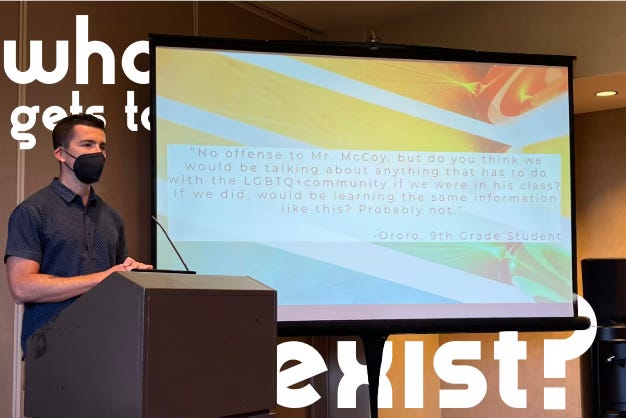
When students are given space to see their experiences reflected in their learning, they aren’t just learning—they are validating their existence. I’ve seen this happen firsthand, whether it was students using social media as a research tool to center the needs of their own communities, or the shift in energy when a lesson included voices that looked, spoke, and lived like them.
The impact isn’t just academic. It’s personal. It’s about confidence. Belonging. Agency. It’s about knowing that you are part of the world, not an outsider looking in.
For those who argue that education should only focus on reading, writing, and math because that's what students need for a job—consider this:
The modern world requires more than rote memorization and standardized test scores. It requires media literacy to navigate a digital landscape filled with misinformation, critical thinking to challenge oppressive systems, and social awareness to collaborate in a globalized workforce. Jobs don’t exist in a vacuum—neither should education.
making representation more than a buzzword
So where do we go from here? What does it look like to move past passive representation and into active, intentional inclusion?
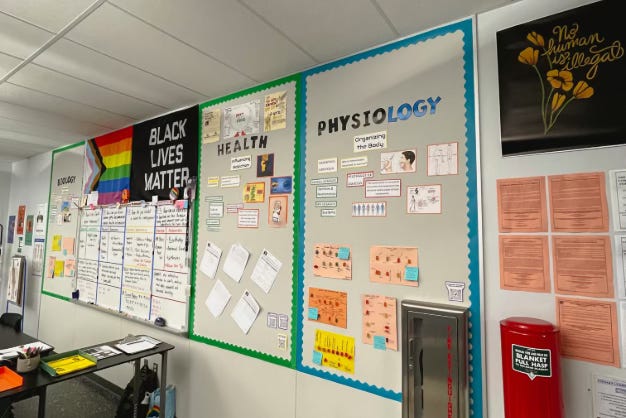
For educators: This means integrating culturally responsive curriculum and actually learning about the needs of the communities we serve, fighting against the erasure of marginalized histories, and refusing to be complicit in outdated, exclusionary policies.
For parents: This means making sure children grow up with access to diverse stories, books, and experiences that help them see beyond their own perspectives.
For all of us: It means staying vigilant and LOUD. It means recognizing that every time a book is banned, every time a politician guts DEI, every time a student is told they can’t discuss the real dimensions of their existence in class—that is an act of erasure. And we cannot be complicit in that erasure by doing nothing, or by only screaming into our social media echo chambers.
Representation alone is not enough. It must be backed by consistent, collective action.
we cannot afford to be erased
Many of us have spent years searching for ourselves in books, in the media, in conversations where we felt like we had to justify our existence. No one should have to search that hard to feel like they belong.
The next generation deserves to see themselves in the world—without having to search for proof that they exist. Without having to fight for the right to be represented.
Representation isn’t just about visibility. It’s about survival, validation, and possibility. To be seen is to exist. To be erased is to be told you don’t matter. We cannot afford to be erased.
So who gets to see and be themselves? And what are we doing to make sure the answer is: everyone?
-matt
Wow I love this piece Matt. I was just reflecting on representation this past week and ran up against the same memories of the tragic narratives of queer people from when I was a kid that really haunted my ability to look forward to any sort of life as a queer person.
Within the classroom, I think sharing the narratives of diverse groups of people also supports youth’s ability to recognize and empathize with the people around them which is something so vital to encourage in people, especially when they are young. In a world where that skill set is already being chipped away at because of societies push towards such myopic perspectives, it is even more crucial today than ever before.